
What Torq is, and what it refuses to be.
Torq is a GPS speedometer and drive recorder for iPhone, published by Eversight Studio and on the App Store since May 2026. It records a drive from the phone's GPS and motion sensors, analyzes it on the phone, and keeps the result. This page is how it works and why.
The idea
A car's instruments tell you what is happening and then forget it. A speedometer app that only does the same is a slightly larger dial. Torq's premise is that the interesting part of a drive is what it looked like afterwards: where you were fast, where the road got rough, which corner was taken well, how this week compares with last. So it records the live moment and turns it into a record with the signals a driver would actually want to inspect.
The second premise is that those signals should be computed honestly. Consumer driving apps tend to be black boxes with a number at the end. Torq's analysis is a set of named thresholds, formulas drawn from published research on driving comfort and vehicle dynamics, and a GPS filter drawn from the GNSS outlier literature. The research page prints the sources.
Who makes it
Eversight Studio LLC, a small studio in Cheyenne, Wyoming, that builds iPhone apps. The studio's site is eversight.io, and the person who answers hello@eversight.io is the person who builds the app.
Five decisions that shaped the app
GPS first, sensors second
Speed, distance, lateral G and braking G all come from the GPS trace, because Doppler speed does not care how the phone is oriented. The accelerometer and gyroscope are reserved for the questions they answer well: is this a real yaw, and how rough is the road. No calibration step, at the cost of one-second resolution.
Filter before scoring
Every analysis runs on a cleaned series: fixes with poor reported accuracy are dropped, a robust outlier detector removes spikes, and a plausibility gate rejects accelerations no road car produces. Top speed comes from the cleaned series only. A number you cannot trust is worse than no number.
Analysis on the phone
The route, the speed series, the corners and every score are computed on the iPhone and stored there. There is no account, no login and no server holding drives. The app works the same in a tunnel, on a mountain and in a country far from any server.
Passive by design
Every feature that shows the speed outside the app exists so that there is no reason to touch the phone while the car moves. The app asks you to accept a safety notice before the first drive and never prompts mid-drive.
The data is yours
Any drive exports as a standard GPX track, a CSV summary or the raw sensor file, and the raw file imports back into Torq on another phone. There is no format that only the app can read.
What it refuses to claim
- That it is a measuring instrument. It is a phone. The readings are informational.
- That its score says how safe a driver you are. It says how a drive looked to a set of formulas.
- That the analysis means the same on a motorcycle or a boat. Speed and distance transfer; the cornering and comfort grades are calibrated for a car with the phone in a mount.
- That it has features it does not: no lap timing, no speed-camera warnings, no windshield reflection mode, no Apple Watch app.
- A rating. Torq is new on the App Store and this site publishes none until there are real ones.
The app, in numbers
- iPhone, iOS 17 or later. Eleven languages: English, Arabic, French, German, Italian, Japanese, Korean, Polish, Spanish, Swedish and Traditional Chinese.
- App Store category: Navigation. Export formats: GPX 1.1, CSV, DPSE.
- Score weights: smoothness 30%, cornering 30%, speed control 25%, efficiency 15%.
- Corner ratings S, A, B, C; comfort grades A+ to F on ISO 2631-1; road grades A to F on an IRI-style scale.
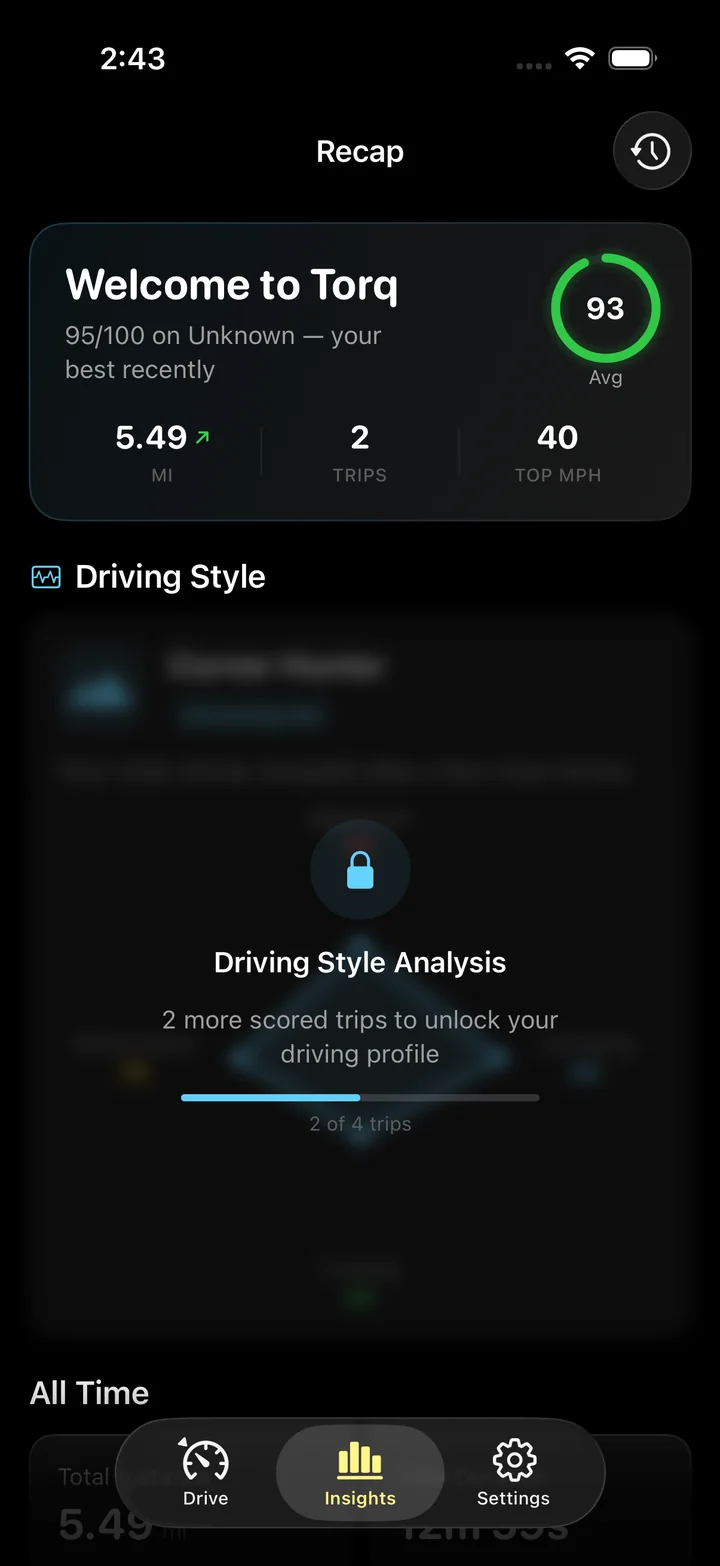
- Driving style profile after four scored trips, one of six tags.
Built to be checked.
Every threshold in the analysis is a named number, the formulas are on this site, and the raw data is exportable. Record a drive and look.