
How accurate is a GPS speedometer?
More accurate than the dial in your car on an open road, and worse than it in a tunnel. Here is where the phone's number comes from, how far to trust it, and what Torq does about the cases where it goes wrong.
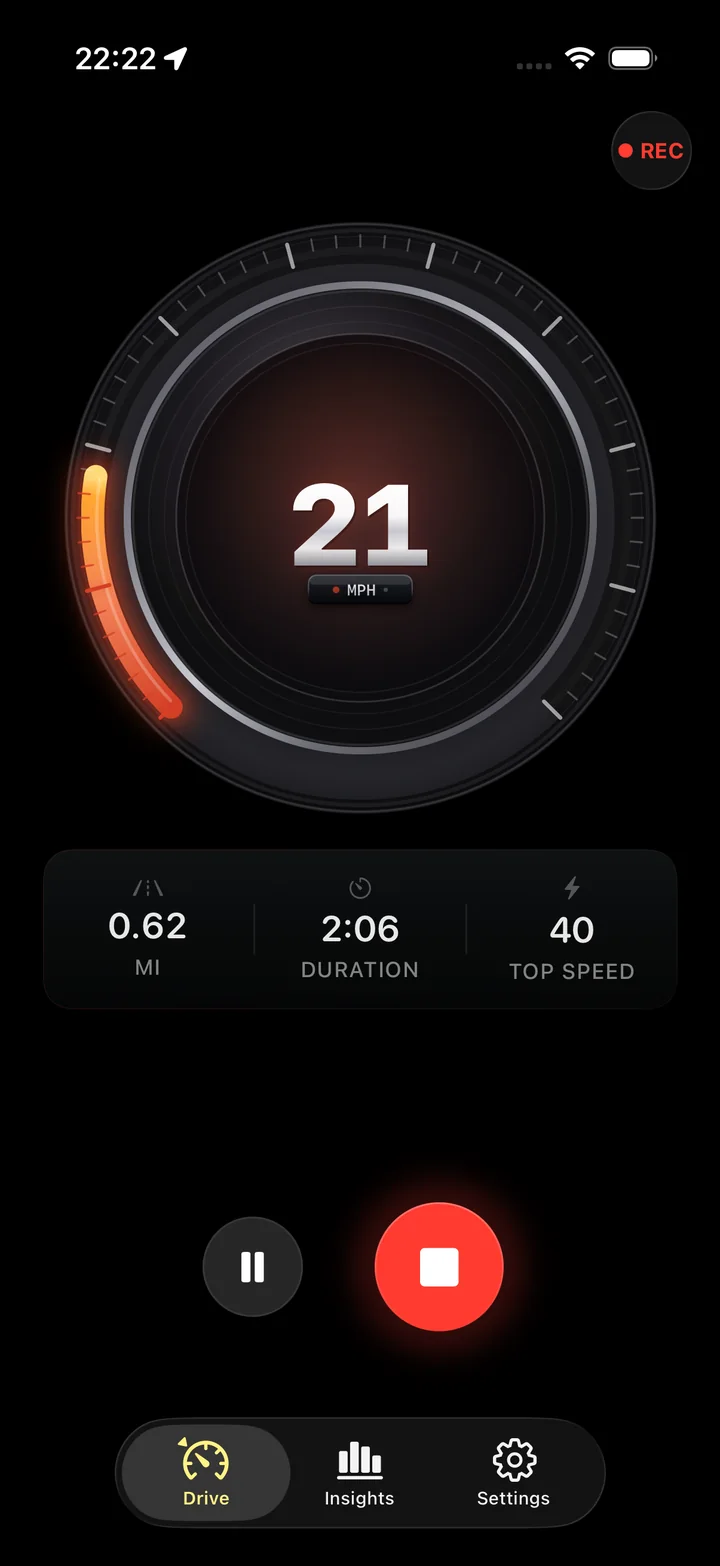
The short answer, in numbers
Why GPS speed is better than you would guess
A receiver does not compute speed by subtracting one position from the next. Positions from a phone are good to a few meters, and a few meters per second of error would be useless. Instead it measures the Doppler shift of each satellite's signal, which gives the velocity toward or away from that satellite directly, and solves for the receiver's velocity across all of them. Doppler velocity is good to about 0.1 meters per second, which is why the speed on the phone is steadier than the position of the dot on the map.
iOS exposes that speed on every fix, with a course, an altitude and a horizontal accuracy estimate. Torq records all of them. The accuracy field is what lets it decide which fixes to believe: anything reported as worse than 65 meters is dropped before it reaches the route or the speed series.
Why the car reads high
Regulations in most markets forbid a speedometer from reading under the true speed and allow it to read up to about ten percent plus 4 km/h over. Manufacturers bias the dial upward to stay on the right side of that, so a new car on new tires typically shows two to five percent more than it is doing. Tire wear shrinks the rolling circumference and pushes the dial higher still. When a car dial says 70 and a phone says 67, the phone is usually the one telling the truth.
Where GPS goes wrong, and what Torq does
Tunnels and garages
No sky, no fix. Torq watches for the gap in timestamps and the jump in reported accuracy at either end, records a tunnel event, bridges the route in a straight line and keeps the gap out of the analysis. The gauge shows no reading instead of holding the last one.
Urban canyons
Between tall buildings the signal arrives by reflection, and a fix can land on the wrong side of the street or report a speed that is briefly wrong. The accuracy filter removes the worst of these; the outlier filter removes what gets through.
Speed spikes
A raw trace can show 60, 122, 58 km/h in three consecutive seconds. Torq runs a centered Hampel filter over the speed series and a physical plausibility gate behind it, and computes top speed from the cleaned series only. A glitch cannot become your record.
The first second
Fixes arrive at about 1 Hz. During a hard launch the car can gain 10 km/h between two of them, so the gauge trails the true speed by up to that much for a moment. At steady speed the lag disappears.
When the number stops updating, start with the checks for location permission and reception. Fix a missing or frozen speed readout
If the horizontal position looks right but the height does not, examine the vertical measurement. Check GPS altitude accuracy
How to get the best reading
- Mount the phone with a clear view of the sky, on the dashboard or at the top of the windshield.
- Set GPS Accuracy to High for twisty roads, Balanced for long highway drives on battery.
- Expect the reading to trail the car for a second under hard acceleration.
- Read the tunnel markers in the replay as gaps, not as zero speed.
- Compare against the dial at a steady 100 km/h; a dial reading 103 to 108 against a GPS 100 is normal.
Questions
How accurate is a GPS speedometer on a phone?
Under open sky, a phone's GPS speed is typically within 1 to 2 km/h, about 1 mph, of true speed at a steady pace, because the receiver measures speed from the Doppler shift of the satellite signals rather than from position differences. Accuracy degrades in tunnels, parking garages, dense city streets and heavy tree cover.
Why does my car speedometer read higher than GPS?
Because it is designed to. Regulations in most markets require a car's speedometer never to read below the true speed and allow it to read up to about 10 percent plus 4 km/h above it, so manufacturers bias the dial high. Worn tires and smaller aftermarket tires add to the over-read. A GPS reading a few km/h under the dial is the GPS being right.
Which is more accurate, GPS or the car?
GPS, on a clear road at steady speed. The car, in a tunnel, and for the first second of hard acceleration. Neither is a measuring instrument you should rely on for a legal argument.
Is a phone GPS speed accurate enough to check a speedometer?
Yes, for a sanity check at a steady speed on an open road. Hold 100 km/h on the dial and read the phone; a GPS reading of 93 to 97 is the normal over-read of a dial, and a reading above the dial suggests a very worn or undersized tire. It is not a calibration certificate.
Does GPS work in a tunnel?
No. There are no satellites in a tunnel. Torq detects the dropout, marks it as a tunnel event, bridges the route with a straight line, and excludes the gap from the speed and corner analysis.
Does phone placement affect the speed reading?
Very little for speed, since that comes from the satellites; a phone in a pocket still reads speed. It matters a great deal for the motion-sensor grades, which need the phone in a mount to measure the car rather than the seat.
What is the difference between Balanced and High GPS accuracy?
The accuracy mode Torq asks iOS for. High requests the best available fixes at the cost of more battery; Balanced accepts slightly coarser fixes and lasts longer. For the speedometer both are fine; for corner analysis on a twisty road, High gives cleaner heading data.
An honest number, and the reasons it is honest.
Torq filters the GPS trace before it shows you a top speed, marks tunnels instead of guessing through them, and tells you when the limit it shows is inferred.