
Read the road back one corner at a time.
Torq finds every corner in a drive, classifies it from S to C by how demanding it was, records the entry, apex and exit speed and the lateral G, and scores how it was taken.
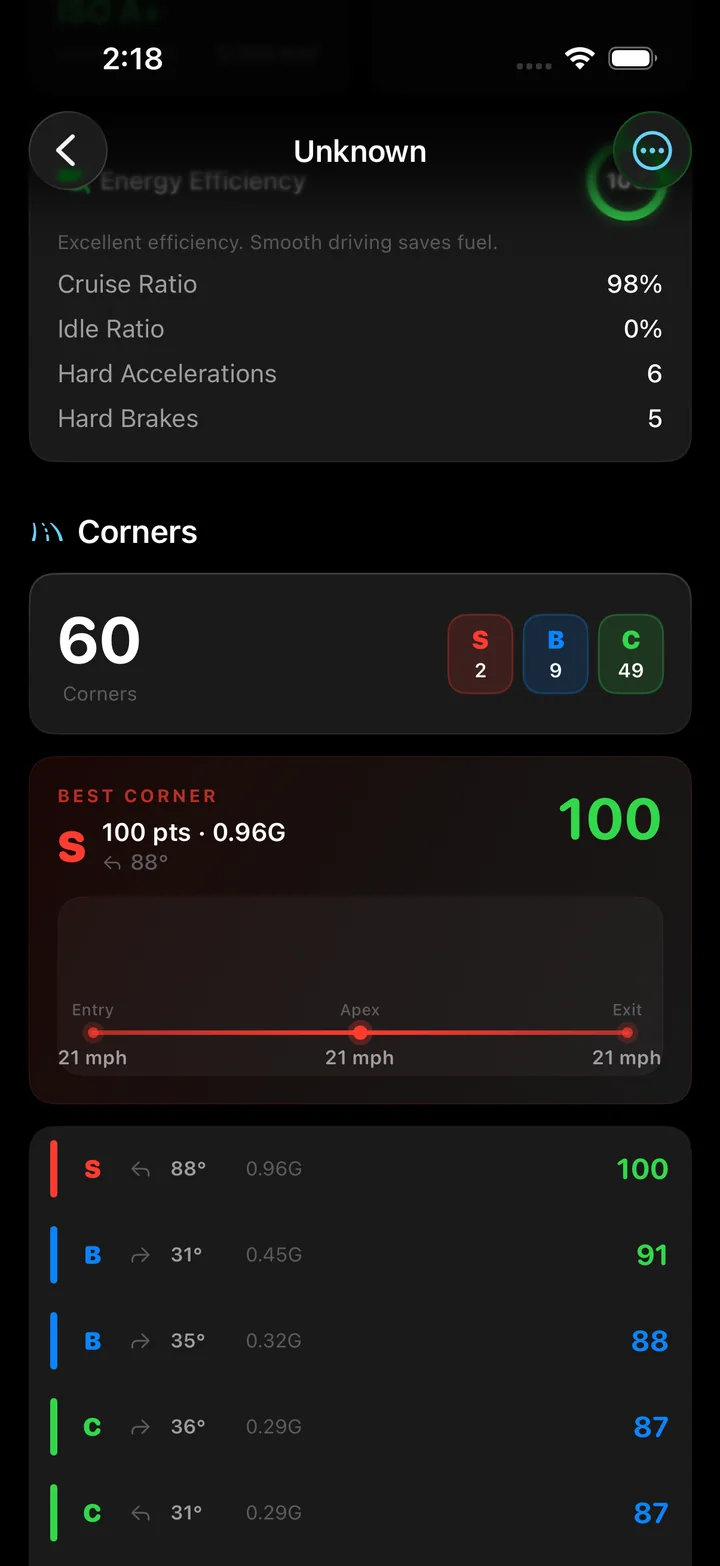
What a corner record holds
| Field | Meaning | Source |
|---|---|---|
| Rating | Difficulty class, S, A, B or C. S is the tightest and fastest, C the gentlest. | Angle, speed and lateral G of the corner |
| Direction and angle | Left or right, and the total heading change in degrees. | GPS course, confirmed by the gyroscope |
| Entry, apex, exit | Speed at the start of the corner, at its slowest point, and at its end. | Filtered GPS speed |
| Lateral G | The 90th percentile of centripetal G through the corner. | Speed times heading rate, per sample |
| Performance score | 0 to 100: speed held to the apex, quality of the exit, grip used. | The three-part formula below |
The performance formula
Half the score is how much of the entry speed survived to the apex. That is the core skill on a road: braking done before the corner, not inside it, so the slowest point is not much slower than the way in. The exit term is asymmetric on purpose. Leaving faster than the apex is good technique and costs nothing; leaving slower is penalized, because it means the corner was still being managed on the way out. The last twenty points reward lateral G, since a corner taken at 0.6 G used more of the tire's grip than the same corner at 0.3.
The letter says what the corner was. The number says how it was driven.
A C-rated sweeper taken cleanly can score 95 and an S-rated hairpin taken badly can score 60, and both facts are useful. The trip detail sorts the corner list with the best corner at the top and shows the count of each rating, so a canyon drive reads as four S, twelve A, nine B and three C.
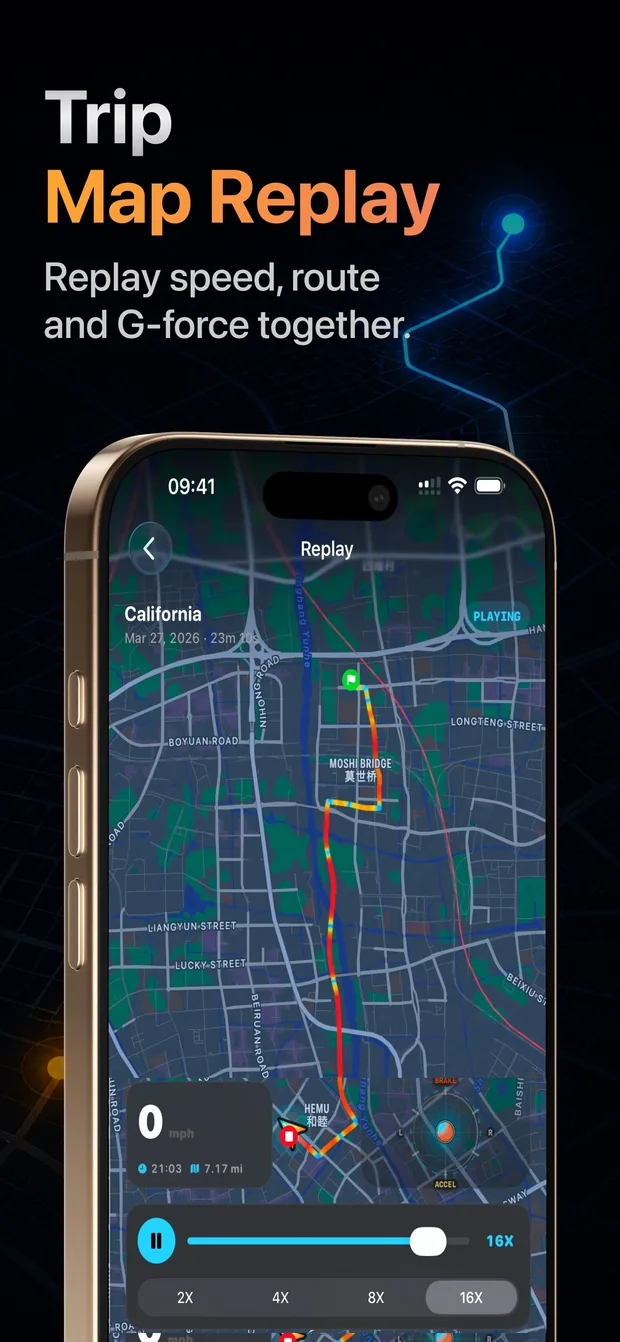
Every corner is also a marker on the replay map, so a road you drive often becomes a set of bends you can compare across days.
- Corner detection: a heading change of at least 22 degrees at a course rate above 12 degrees per second, at 12 km/h or more.
- Corners longer than 35 seconds are split; a long sweeping bend is not one corner.
- Lateral G is the 90th percentile of the per-sample value, so one noisy fix cannot inflate a score.
What the corners feed, and their limits
The average corner performance score, with a penalty for jerk inside corners, is the cornering component of the driving score, which carries 30 percent of the weight. The best corner score across all trips is a personal record. The top corner speed is listed with the vehicle dynamics.
GPS at one fix per second sees a corner as a handful of points. That is enough for a three-second bend and not enough to say much about a chicane taken in under a second. Very slow corners, under about 12 km/h, are excluded because the course reading is unreliable at walking pace. And the analysis is calibrated for a car with the phone in a mount; on a motorcycle, lean angle changes what lateral G means and the ratings will not transfer.
Questions
How does Torq detect a corner?
From the GPS course. When the heading changes faster than a threshold rate and the total change reaches at least 22 degrees, that stretch is a corner; a gentler change of 25 degrees or more is counted as a turn. Corners longer than 35 seconds are split. The gyroscope confirms the yaw is real at low speed.
What do the S, A, B and C ratings mean?
Difficulty, not performance. S is the tightest and fastest class of corner, C the most gentle, based on the angle, the speed at which it was taken and the lateral G involved. A hairpin on a mountain road is S; a highway sweeper is C.
How is the corner performance score calculated?
Three parts, out of 100. Up to 50 points for holding speed into the apex, from the ratio of apex speed to entry speed. Up to 30 for the exit, rewarding leaving faster than the apex. Up to 20 for the lateral G sustained through the corner.
What are entry, apex and exit speed?
Entry is the speed at the start of the detected corner, apex is the slowest point within it, exit is the speed at its end. Good technique on the road is a gentle decline to the apex and a strong rise out; a big drop to the apex means the braking happened inside the corner rather than before it.
Is this a track day app?
It is a road analysis app that also works on a closed course. Torq has no lap timing, no sector times and no track database. What it gives you on a track is the same corner-by-corner record it gives you on a canyon road.
Why does the corner count differ from what I remember?
Torq counts heading changes that exceed the detection thresholds. Roundabouts and sharp junction turns count; gentle highway bends do not, and two bends close together may merge into one if the heading never settles between them. The corner list shows exactly where each one was on the map.
Every corner, graded, with its speeds.
Drive the road, then read it back one bend at a time: rating, entry, apex, exit, lateral G and a score for each.