
A road condition app that measures the road from the seat.
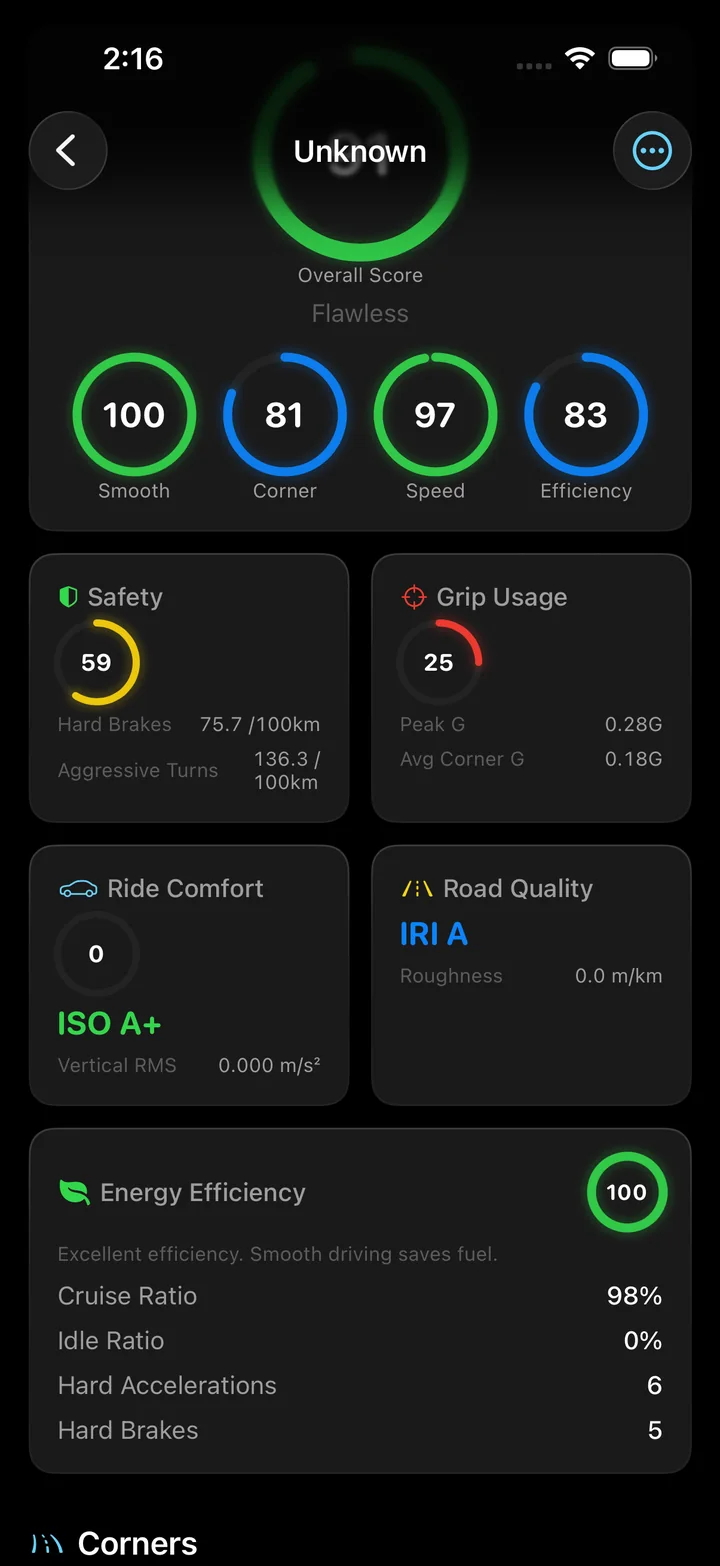
Torq turns the vertical vibration a phone feels in a mount into a ride comfort measurement graded on the ISO 2631-1 scale and a roughness index on the IRI scale that road agencies use, then colors the route by it.
The comfort scale
ISO 2631-1 relates frequency-weighted vertical acceleration to how a seated passenger feels. Torq applies the standard's Wk weighting, which emphasizes the 4 to 8 Hz band where the body is most sensitive, takes the root-mean-square over the moving part of the drive, and grades it on the standard's zones.
| Grade | Vertical RMS, m/s² | ISO description |
|---|---|---|
| A+ | under 0.315 | not uncomfortable |
| A | 0.315 to 0.50 | a little uncomfortable |
| B | 0.50 to 0.80 | fairly uncomfortable |
| C | 0.80 to 1.25 | uncomfortable |
| D | 1.25 to 2.00 | very uncomfortable |
| F | over 2.00 | extremely uncomfortable |
The roughness scale
The International Roughness Index, in meters of vertical movement per kilometer of road, is how highway agencies rate pavement. A new motorway is around 1 m/km; a rough rural road is 5 or more. Torq estimates an IRI-style value from the phone's vibration and grades it with two sets of thresholds, because a manhole cover on a city street is not a defect at 30 km/h.
| Grade | Highway, 50 km/h and up | Urban, under 50 km/h |
|---|---|---|
| A | under 1.5 m/km | under 3.5 m/km |
| B | 1.5 to 3.0 | 3.5 to 5.5 |
| C | 3.0 to 4.5 | 5.5 to 8.0 |
| D | 4.5 to 6.0 | 8.0 to 12.0 |
| F | over 6.0 | over 12.0 |
See where the road was rough.
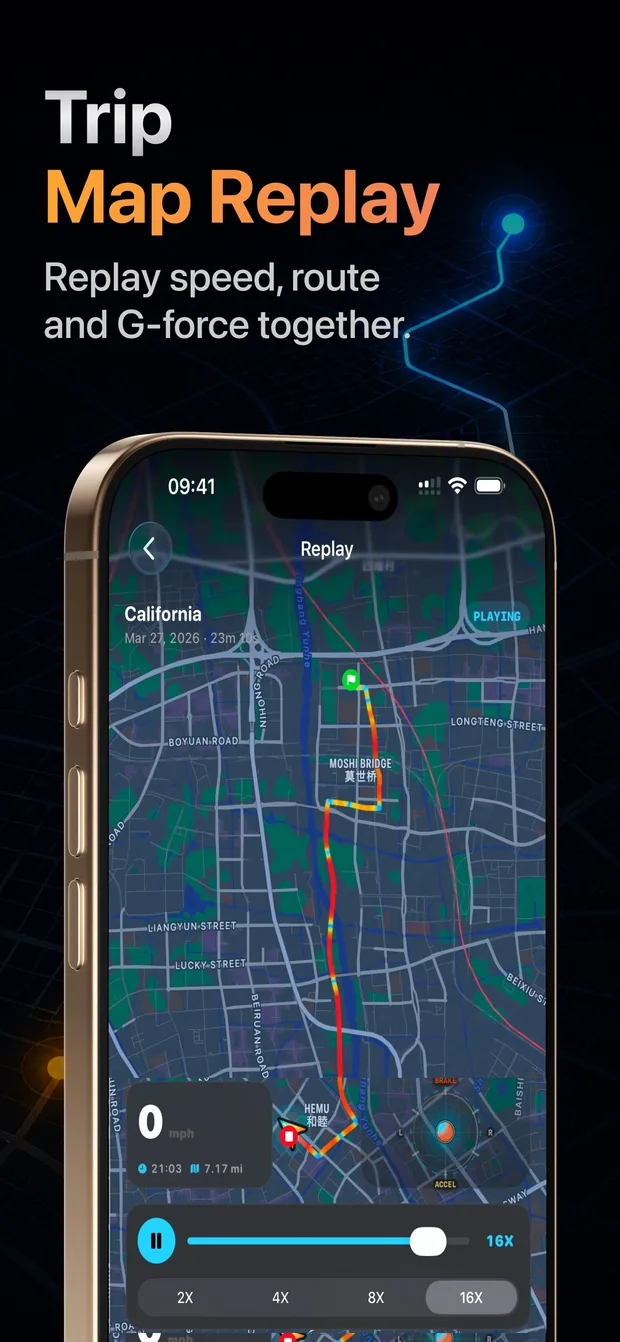
The replay map's Road color mode paints the route by roughness, so the bad stretch of a commute shows up as a red section you can scrub to. Both grades sit in the trip detail beside the driving score, with the vertical RMS and the roughness value under them.
Because the raw vertical channel is part of the sensor recording, the DPSE export carries it out of the app for anyone who wants to look closer.
Why the number is an estimate, and what it is good for
A road agency measures IRI with a profiler that reads the pavement directly. A phone reads the pavement through tires, suspension, seat and mount, and each of those changes the answer: a sports car on hard tires reports a rougher road than a sedan on the same asphalt. Samples above 3.0 g are discarded as phone drops, and stationary time is excluded, since a car idling at a light measures the engine, not the road.
Within one car the comparison is fair, and that is what the grade is for: this road against that one, this month's commute against last month's, the stretch that got repaved against the one that did not. A grade you can repeat is a grade you can act on.
Questions
How can a phone measure road quality?
Through the seat. The car's suspension turns the road profile into vertical acceleration in the cabin, and the phone's accelerometer measures that. Torq filters and frequency-weights the vertical channel as ISO 2631 specifies, computes its root-mean-square, and converts the result to a comfort grade and a roughness index.
What is IRI?
The International Roughness Index, in meters of vertical movement per kilometer of road, the standard way highway agencies rate pavement. Torq estimates an IRI-style value from the phone's vibration; it is an estimate, because the car sits between the road and the phone, but on the same car it is consistent from road to road.
What is the ride comfort grade?
The ISO 2631-1 scale, which maps frequency-weighted vertical RMS acceleration to how a passenger feels: A+ under 0.315 m/s² is not uncomfortable, A to 0.50 a little uncomfortable, B to 0.80 fairly uncomfortable, C to 1.25 uncomfortable, D to 2.00 very uncomfortable, F above that extremely uncomfortable.
Why do the road grades change with speed?
Because the same pavement feels different at 30 and at 100 km/h, and because urban roads have manhole covers and patches that would fail a highway threshold while being normal for a city street. Torq uses one set of thresholds when the average speed is 50 km/h or more and a more forgiving set below that.
Is this grading my driving or the road?
Mostly the road and the car. A stiffly sprung car on a rough road will grade worse than a soft one on the same road regardless of who is driving. The grades sit beside the driving score rather than inside it for that reason.
Can I see where a road was rough?
Yes. The replay map has a Road color mode that colors the route by roughness, so the bad stretch of a commute shows up as a red section you can scrub to.
A rough road, measured instead of remembered.
Mount the phone, drive the road, and read back a comfort grade on the ISO scale and a roughness index on the IRI scale.